
BIOPARC Valencia is contributing with great success to its salvation with the birth of 12 specimens of Mhorr gazelles since 2014 and their transfer to other preservation centers.
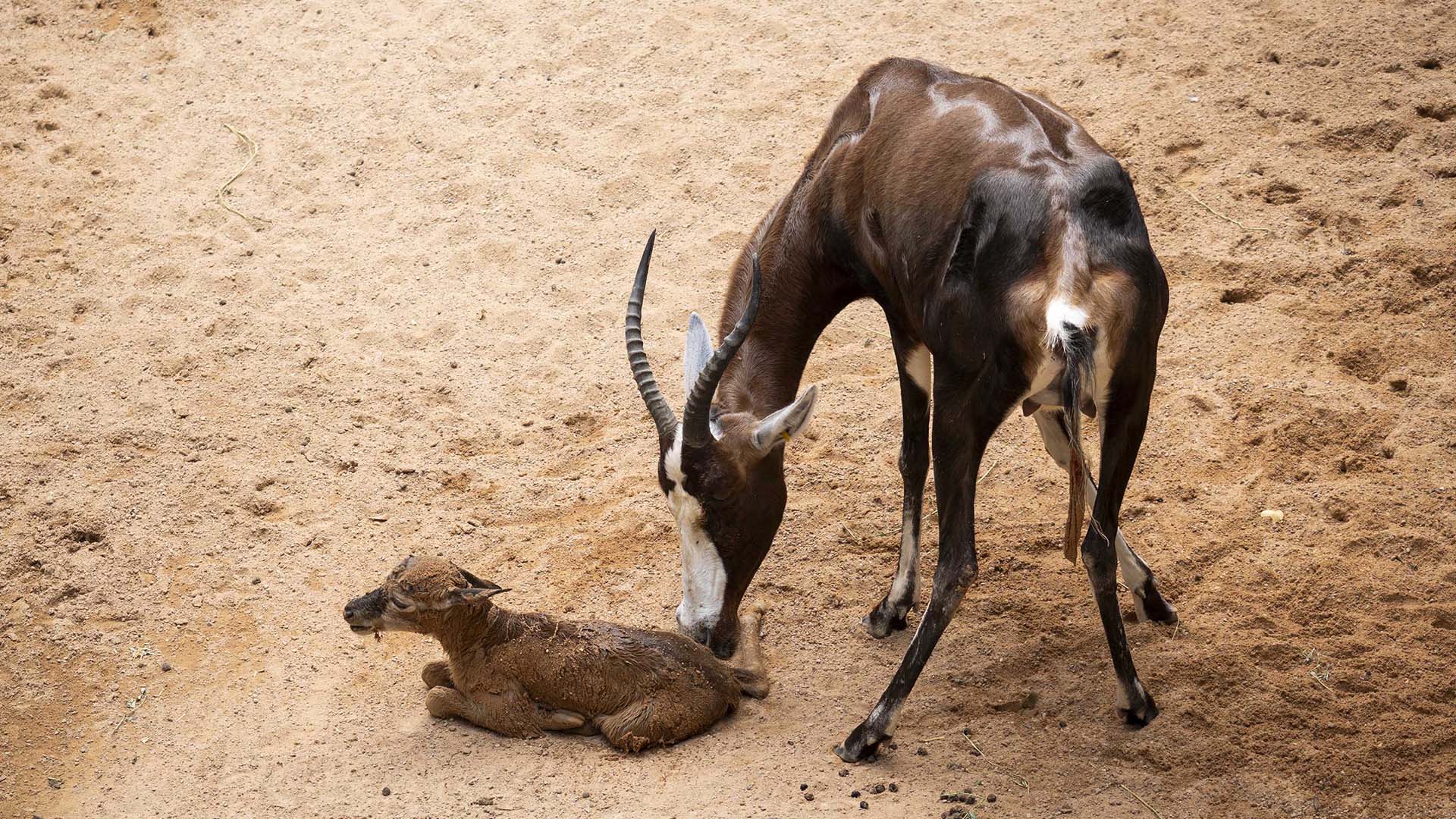
Spring has brought BIOPARC Valencia “hope” for the conservation of the planet's biodiversity and, on this occasion, with the excitement of attending one of the most beautiful moments of nature, the birth of a beautiful male Mhorr gazelle. The entire herd attended the birth, which took place normally and now, with just a few days of life, we can see the calf suckling and running around with the adults. The reproductive group, made up of one male and three females, is part of the International Species Conservation Program (EEP) and BIOPARC is located in the savannah zone, in a multispecies enclosure that it shares with other antelopes, the addax (Addax nasomaculatus), the grey-necked crowned crane (Balearica regulorum) and the spurred tortoise (Centrochelys sulcata).
The Mhorr gazelle.
The Mhorr gazelle (Nanger dama mhorr) is a beautiful gazelle It is distinguished by its white fur covered with a reddish brown color on its back and its characteristic “s”-shaped horns. Also known as “lady” for the elegance of its slender legs and long neck. It is the largest gazelle in the world and unfortunately one of the species that became extinct in its habitat and that survives on the planet thanks to a Spaniard, Professor José Antonio Valverde, who rescued a group of 11 specimens from the Sahara from which they all descend. those that are today found in different conservation institutions, among which BIOPARC Valencia stands out.

The infamous red list of the International Union for Conservation of Nature (IUCN) includes Mhorr gazelle as “critically threatened” with extinction, which motivated BIOPARC Valencia to join very actively in 2014 with the international institutions that are fighting intensely to guarantee its survival. With the formation of the Valencian group, practically since their arrival, each year they have reproduced successfully and there are now 12 offspring that have been born in the park and many of them have grown up. This little-known species of antelope has become a conservation icon, example of the very important work of animal parks and the necessary international cooperation to avoid the loss of biodiversity.
In this context, every birth is excellent news, since currently this species has been able to begin to be reintroduced into its natural environment and 5 initiatives are already being developed: Morocco (Bou-Hedma National Park and Domaine Royal R'Mila), Senegal (Guembeul Fauna Reserve and Ferlo North Fauna Reserve) and Tunisia (Bou Hedma National Park), thanks to the international cooperation of different institutions.